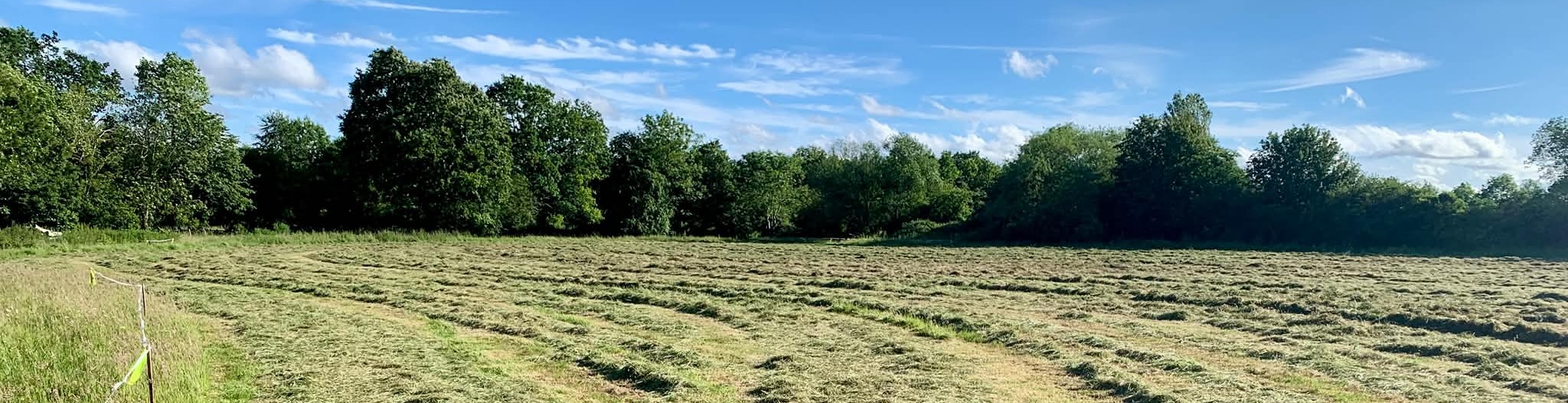
If you’ve walked past Bentley Green over the last few days, you might have noticed a sudden and dramatic change. The grass has been mown close, and the clippings removed. For anyone passionate about seeing nature thrive, a freshly cut field can sometimes feel counterintuitive. Why cut now?
The answer lies in a specialised, scientifically proven conservation method known as “Cut and Collect.” This action is actually the crucial first milestone in our ambitious, multi-year vision to transform Bentley Green from a species-poor field into a rich tapestry of wildlife habitats – featuring a community orchard, native wildflower meadows and grassland, providing vital habitats for insects, mammals, amphibians, reptiles and birds.
Here is an overview of the ecological science behind why we have just cut the Green, how it feeds into our master plan, and how you can get involved.
1. The Paradox of Wildflowers: Why Less is More
To understand why we cut, we first have to understand what wildflowers need to thrive. Coarse grasses grow rapidly, thickly, and aggressively. They love high-nutrient soils, particularly those rich in nitrogen and phosphorus. When soil fertility is high, coarse grasses dominate the landscape, physically choking out and outcompeting the delicate wild flora we wish to establish.
Wildflowers, conversely, thrive in low-nutrient, impoverished soils. By deploying a “cut and collect” system – where the grass is mown and the cuttings are immediately removed – we prevent those clippings from rotting back into the earth. Each cycle of collection physically extracts nutrients from the soil system. Over time, this systematically dampens the vigour of aggressive grasses, clearing structural space and lowering fertility so that a colourful, diverse array of native wildflowers and grasses can finally gain a permanent foothold.
Our Current Timeline
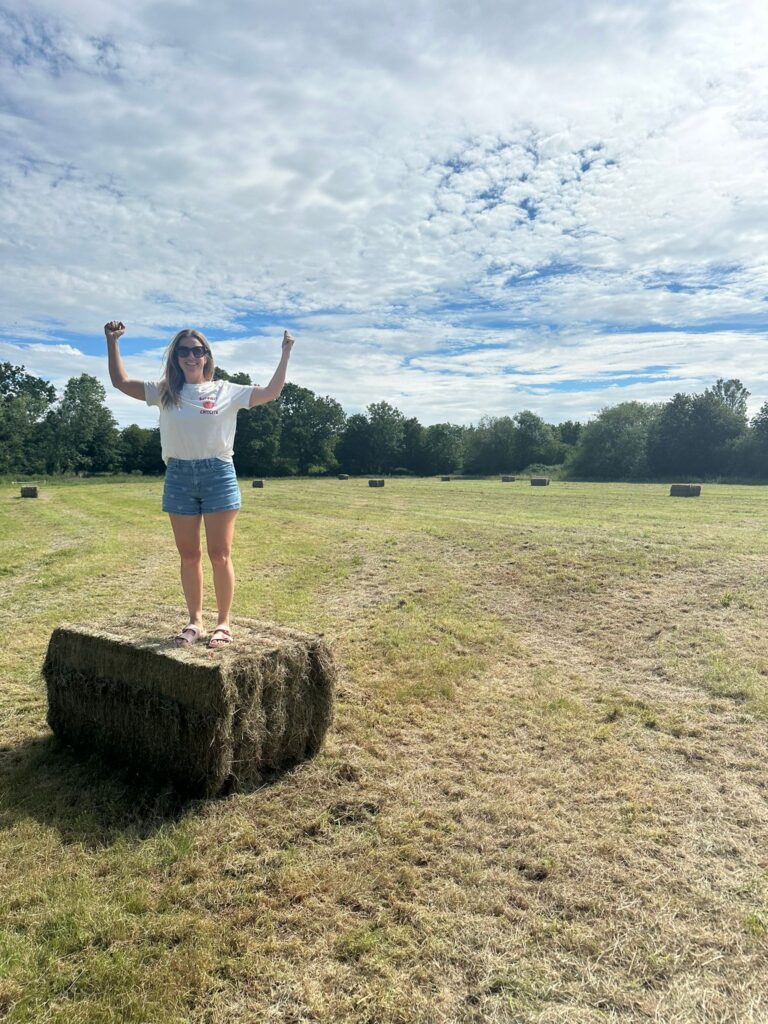
An ordinary annual cut and collect routine, typically three cuts per year, initiates this improvement, but it can take a number of years to see dramatic changes. Because we are kicking off this process with our current June cut, we are aiming to complete a second “cut and collect” around September to help fast-track the reduction of grass vigour before winter. Moving forward into future years, we will settle into a sustainable, long-term rhythm of one or two strategic cuts per year.
2. What About the Orchard?
With our plans to start planting the community orchard this coming winter, a natural question arises: If we are intentionally lowering the soil nutrients for wildflowers, won’t that harm the new saplings?
The short answer is no, and here is why you don’t need to worry:
- Deep Roots vs. Shallow Grass: The nutrient depletion from our cut-and-collect routine primarily impacts the top layer of soil where aggressive grass roots feed. Tree saplings tap into much deeper soil layers, meaning the low-nutrient surface soil won’t have a negative impact on their establishment.
- Targeted Care: When the saplings are planted this winter, we can give them localised support (such as mulching or specific organic matter right around their base) if needed, ensuring they get the perfect start without enriching the surrounding meadow.
- No More Blanket Cutting: Once the orchard trees are safely in the ground, we will no longer be doing a single, uniform blanket cut across the entire site. Instead, our management will become highly localised. We will carefully cut paths and meadow glades while leaving the areas directly around the trees to be managed by our orchard team.
3. A Master Plan for Biodiversity: Orchard, Meadows & Beyond
The recent cut is preparing the canvas for an integrated network of habitats across Bentley Green. Over the coming years, you will see the site structurally diversify into several distinct zones:
- Community Fruit Orchard: Providing structural depth, beautiful spring blossom for early queen bumblebees, and fresh produce for the local community and foraging birds alike.
- Species-Rich Wildflower Meadows: Open, sun-drenched areas specifically managed via low-fertility cycles to maximise the abundance of pollinator-friendly native blooms.
- Uncut Wildlife Margins: We are deliberately leaving structural buffers of tall, dense grasses around the site’s boundaries. These act as vital overwintering sanctuaries for insects and small mammals.
- Nettle Sanctuaries: By protecting and planting robust patches of stinging nettles in sunny, sheltered spots, we are securing crucial foodplants for the caterpillars of beautiful Red Admiral and Peacock butterflies.
- Native Copse: As well as fruit trees we also plan to introduce some native tree species to create a wood pasture habitat.
Why Not Conservation Grazing? Everything is on the table. In fact, we expect a small herd of sheep to visit soon. Conservation grazing with cattle or sheep is an incredible tool used by organisations like the Hampshire and Isle of Wight Wildlife Trust (HIOWWT), and so we will trial this approach over the next few weeks or months. While it might seem counterintuitive since sheep droppings could add unwanted fertility back into the soil, HIWWT advises that this is negotiable and as the sheep won’t receive any supplementary feeding while on Bentley Green, they won’t introduce nutrients from other sources – just what’s already on site. This is a short-term, targeted trial and we’ll be reviewing the results closely afterwards before deciding on next steps.
4. Scientific Monitoring: Keeping Track of Progress
How will we know our efforts are working? Over the last few weeks our ecology team has been conducting various surveys which provide a baseline framework to track changes over time. They’ve also created an annual ecology survey calendar to record all kinds of species over the years. More on this in a future article!
At the same time, we are using tools like the iNaturalist app to record what we’ve seen and build a photographic database of flora and fauna on the site.
5. Get Involved: Join Our Team
This project belongs to the whole community, and we cannot do it alone! Whether you have a background in science, a passion for trees, or just want to give back to your local environment, there is a place for you. We are looking for enthusiastic volunteers to join our dedicated Orchard Team or our Ecology Team to help hands-on with site management and species monitoring. If this isn’t your thing, we would love support behind the scenes with fundraising, community engagement, and event planning.
In addition to our core volunteer working parties, we are organising a variety of community activities throughout the year, ranging from butterfly counts to guided history walks. To see what’s coming up and find out how you can participate, check out our events page at bentleywildlife.org/events/.
The recent short cut might look stark today, but it is the critical catalyst for a blooming, buzzing future!